 Add to Chrome
 Add to Firefox
 Add to Edge
ESAM++: Efficient Online 3D Perception on the Edge
May 28, 2026
Online 3D scene perception in real time is essential for robotics, AR/VR, and autonomous systems, particularly in edge computing scenarios where computational resources are limited and privacy is crucial. Recent state-of-the-art methods like EmbodiedSAM (ESAM) demonstrate the promise of online 3D perception by leveraging the Segment Anything Model (SAM) for real-time, fine-grained, and generalized 3D instance segmentation. However, ESAM still relies on a computationally expensive 3D sparse UNet for point cloud feature extraction, which accounts for the majority of the 3D inference time, hindering its practicality on resource-constrained devices. In this paper, we propose ESAM++, a lightweight and scalable alternative for online 3D scene perception tailored to edge devices without GPU acceleration. Our method introduces a 3D Sparse Feature Pyramid Network (SFPN) that efficiently captures multi-scale geometric features from streaming 3D point clouds while significantly reducing computational overhead and model size. We evaluate our approach on four challenging segmentation benchmarks, namely ScanNet, ScanNet200, SceneNN, and 3RScan, demonstrating that our model achieves competitive accuracy with up to 3 times faster inference with a 2 times smaller model size compared to ESAM, enabling practical deployment on edge devices.

Taming Extreme Tokens: Covariance-Aware GRPO with Gaussian-Kernel Advantage Reweighting
May 12, 2026Group Relative Policy Optimization (GRPO) has emerged as a promising approach for improving the reasoning capabilities of large language models. However, it struggles to effectively balance the tradeoff between exploration and exploitation during training, often resulting in suboptimal performance. Motivated by the theoretical insight that changes in entropy are governed by the covariance between token probabilities and their corresponding advantages, we propose a hyperparameter-free, covariance-weighted optimization method that dynamically down-weights extreme token-level updates via a Gaussian kernel. This approach automatically reduces the instability caused by exploration-exploitation trade-off while preserving informative learning signals. Extensive empirical evaluations show that our approach improves downstream performance across reasoning benchmarks compared with GRPO, and effectively stablizes entropy as training progresses.
Fine-Grained Action Segmentation for Renorrhaphy in Robot-Assisted Partial Nephrectomy
Apr 10, 2026Fine-grained action segmentation during renorrhaphy in robot-assisted partial nephrectomy requires frame-level recognition of visually similar suturing gestures with variable duration and substantial class imbalance. The SIA-RAPN benchmark defines this problem on 50 clinical videos acquired with the da Vinci Xi system and annotated with 12 frame-level labels. The benchmark compares four temporal models built on I3D features: MS-TCN++, AsFormer, TUT, and DiffAct. Evaluation uses balanced accuracy, edit score, segmental F1 at overlap thresholds of 10, 25, and 50, frame-wise accuracy, and frame-wise mean average precision. In addition to the primary evaluation across five released split configurations on SIA-RAPN, the benchmark reports cross-domain results on a separate single-port RAPN dataset. Across the strongest reported values over those five runs on the primary dataset, DiffAct achieves the highest F1, frame-wise accuracy, edit score, and frame mAP, while MS-TCN++ attains the highest balanced accuracy.
DebugLM: Learning Traceable Training Data Provenance for LLMs
Mar 18, 2026Large language models (LLMs) are trained through multi-stage pipelines over heterogeneous data sources, yet developers lack a principled way to pinpoint the specific data responsible for an observed behavior. This lack of observability reduces debugging to reactive patching and makes failures prone to recur under distribution shift or subsequent model updates. To address this limitation, we propose DebugLM, a framework that equips LLMs with built-in data provenance, enabling them to explicitly trace the origins of their behaviors to specific training data sources. Specifically, the model learns to associate its responses with unique provenance tags that indicate the responsible dataset, empowering developers to precisely identify where undesirable behaviors are learned. Building on this capability, DebugLM further supports targeted test-time remediation, enabling developers to selectively trigger targeted refusal for specified data sources without retraining or modifying model parameters. Experiments demonstrate that DebugLM provides accurate behavior tracing in multi-stage training pipelines and effective test-time remediation while preserving the general utility of the model.
Human-LLM Collaborative Feature Engineering for Tabular Data
Jan 28, 2026Large language models (LLMs) are increasingly used to automate feature engineering in tabular learning. Given task-specific information, LLMs can propose diverse feature transformation operations to enhance downstream model performance. However, current approaches typically assign the LLM as a black-box optimizer, responsible for both proposing and selecting operations based solely on its internal heuristics, which often lack calibrated estimations of operation utility and consequently lead to repeated exploration of low-yield operations without a principled strategy for prioritizing promising directions. In this paper, we propose a human-LLM collaborative feature engineering framework for tabular learning. We begin by decoupling the transformation operation proposal and selection processes, where LLMs are used solely to generate operation candidates, while the selection is guided by explicitly modeling the utility and uncertainty of each proposed operation. Since accurate utility estimation can be difficult especially in the early rounds of feature engineering, we design a mechanism within the framework that selectively elicits and incorporates human expert preference feedback, comparing which operations are more promising, into the selection process to help identify more effective operations. Our evaluations on both the synthetic study and the real user study demonstrate that the proposed framework improves feature engineering performance across a variety of tabular datasets and reduces users' cognitive load during the feature engineering process.
FRIEDA: Benchmarking Multi-Step Cartographic Reasoning in Vision-Language Models
Dec 08, 2025Cartographic reasoning is the skill of interpreting geographic relationships by aligning legends, map scales, compass directions, map texts, and geometries across one or more map images. Although essential as a concrete cognitive capability and for critical tasks such as disaster response and urban planning, it remains largely unevaluated. Building on progress in chart and infographic understanding, recent large vision language model studies on map visual question-answering often treat maps as a special case of charts. In contrast, map VQA demands comprehension of layered symbology (e.g., symbols, geometries, and text labels) as well as spatial relations tied to orientation and distance that often span multiple maps and are not captured by chart-style evaluations. To address this gap, we introduce FRIEDA, a benchmark for testing complex open-ended cartographic reasoning in LVLMs. FRIEDA sources real map images from documents and reports in various domains and geographical areas. Following classifications in Geographic Information System (GIS) literature, FRIEDA targets all three categories of spatial relations: topological (border, equal, intersect, within), metric (distance), and directional (orientation). All questions require multi-step inference, and many require cross-map grounding and reasoning. We evaluate eleven state-of-the-art LVLMs under two settings: (1) the direct setting, where we provide the maps relevant to the question, and (2) the contextual setting, where the model may have to identify the maps relevant to the question before reasoning. Even the strongest models, Gemini-2.5-Pro and GPT-5-Think, achieve only 38.20% and 37.20% accuracy, respectively, far below human performance of 84.87%. These results reveal a persistent gap in multi-step cartographic reasoning, positioning FRIEDA as a rigorous benchmark to drive progress on spatial intelligence in LVLMs.
ArenaBencher: Automatic Benchmark Evolution via Multi-Model Competitive Evaluation
Oct 09, 2025


Benchmarks are central to measuring the capabilities of large language models and guiding model development, yet widespread data leakage from pretraining corpora undermines their validity. Models can match memorized content rather than demonstrate true generalization, which inflates scores, distorts cross-model comparisons, and misrepresents progress. We introduce ArenaBencher, a model-agnostic framework for automatic benchmark evolution that updates test cases while preserving comparability. Given an existing benchmark and a diverse pool of models to be evaluated, ArenaBencher infers the core ability of each test case, generates candidate question-answer pairs that preserve the original objective, verifies correctness and intent with an LLM as a judge, and aggregates feedback from multiple models to select candidates that expose shared weaknesses. The process runs iteratively with in-context demonstrations that steer generation toward more challenging and diagnostic cases. We apply ArenaBencher to math problem solving, commonsense reasoning, and safety domains and show that it produces verified, diverse, and fair updates that uncover new failure modes, increase difficulty while preserving test objective alignment, and improve model separability. The framework provides a scalable path to continuously evolve benchmarks in step with the rapid progress of foundation models.
False Sense of Security: Why Probing-based Malicious Input Detection Fails to Generalize
Sep 04, 2025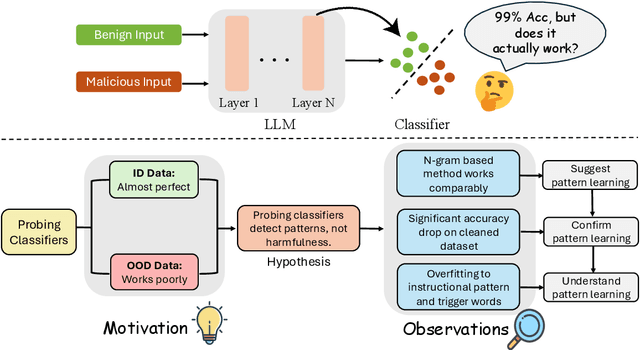
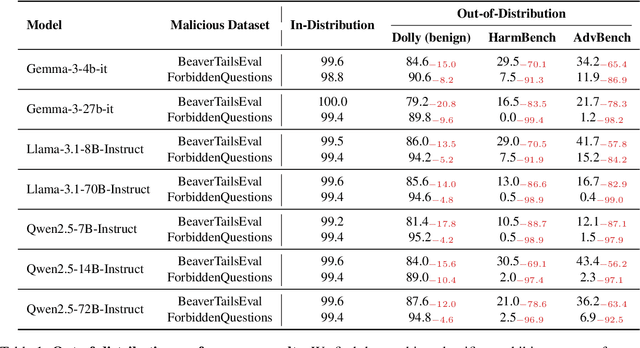
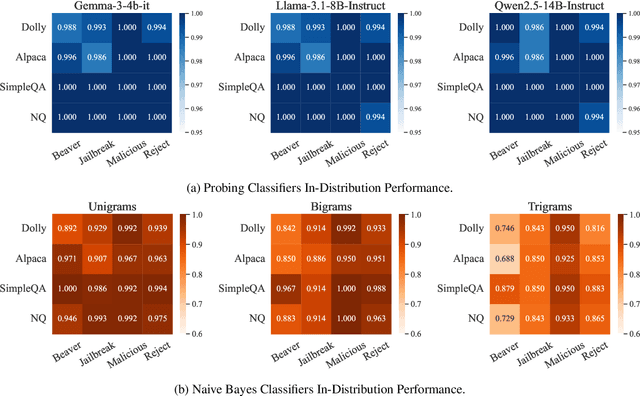
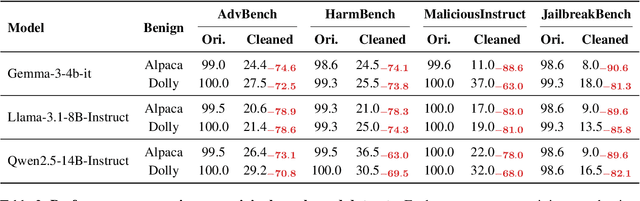
Large Language Models (LLMs) can comply with harmful instructions, raising serious safety concerns despite their impressive capabilities. Recent work has leveraged probing-based approaches to study the separability of malicious and benign inputs in LLMs' internal representations, and researchers have proposed using such probing methods for safety detection. We systematically re-examine this paradigm. Motivated by poor out-of-distribution performance, we hypothesize that probes learn superficial patterns rather than semantic harmfulness. Through controlled experiments, we confirm this hypothesis and identify the specific patterns learned: instructional patterns and trigger words. Our investigation follows a systematic approach, progressing from demonstrating comparable performance of simple n-gram methods, to controlled experiments with semantically cleaned datasets, to detailed analysis of pattern dependencies. These results reveal a false sense of security around current probing-based approaches and highlight the need to redesign both models and evaluation protocols, for which we provide further discussions in the hope of suggesting responsible further research in this direction. We have open-sourced the project at https://github.com/WangCheng0116/Why-Probe-Fails.
QA-LIGN: Aligning LLMs through Constitutionally Decomposed QA
Jun 09, 2025


Alignment of large language models with explicit principles (such as helpfulness, honesty, and harmlessness) is crucial for ensuring safe and reliable AI systems. However, standard reward-based alignment methods typically collapse diverse feedback into a single scalar reward, entangling multiple objectives into one opaque training signal, which hinders interpretability. In this work, we introduce QA-LIGN, an automatic symbolic reward decomposition approach that preserves the structure of each constitutional principle within the reward mechanism. Instead of training a black-box reward model that outputs a monolithic score, QA-LIGN formulates principle-specific evaluation questions and derives separate reward components for each principle, making it a drop-in reward model replacement. Experiments aligning an uncensored large language model with a set of constitutional principles demonstrate that QA-LIGN offers greater transparency and adaptability in the alignment process. At the same time, our approach achieves performance on par with or better than a DPO baseline. Overall, these results represent a step toward more interpretable and controllable alignment of language models, achieved without sacrificing end-task performance.
Exploring Scaling Laws for EHR Foundation Models
May 29, 2025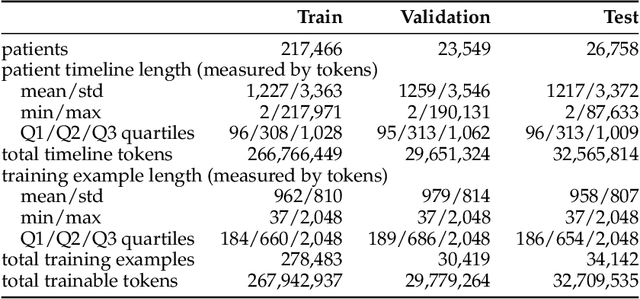
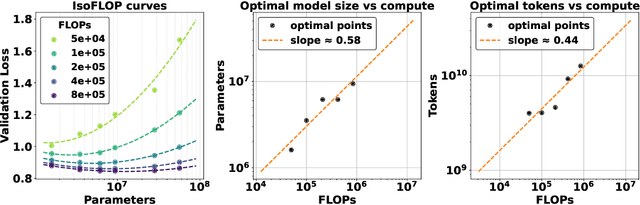
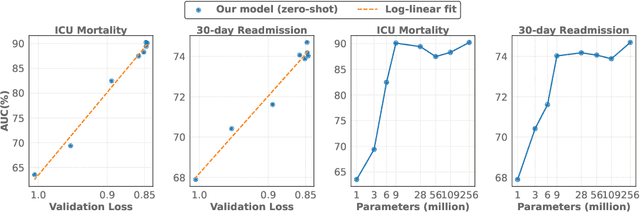
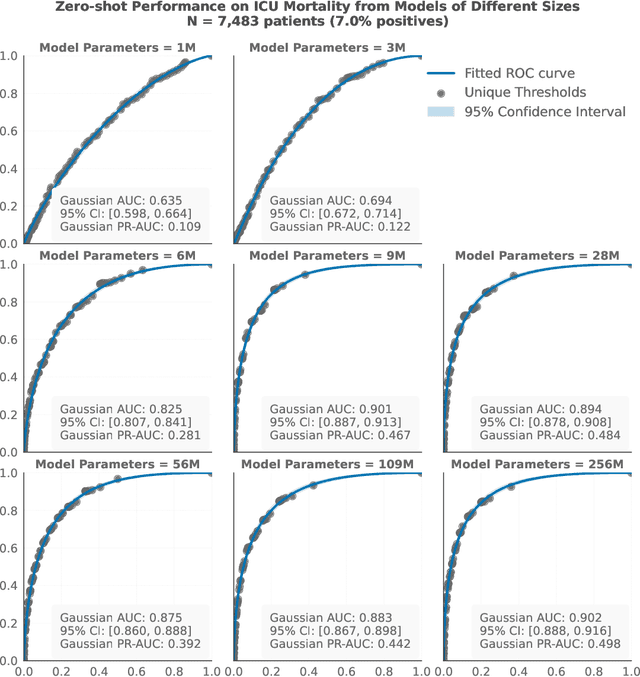
The emergence of scaling laws has profoundly shaped the development of large language models (LLMs), enabling predictable performance gains through systematic increases in model size, dataset volume, and compute. Yet, these principles remain largely unexplored in the context of electronic health records (EHRs) -- a rich, sequential, and globally abundant data source that differs structurally from natural language. In this work, we present the first empirical investigation of scaling laws for EHR foundation models. By training transformer architectures on patient timeline data from the MIMIC-IV database across varying model sizes and compute budgets, we identify consistent scaling patterns, including parabolic IsoFLOPs curves and power-law relationships between compute, model parameters, data size, and clinical utility. These findings demonstrate that EHR models exhibit scaling behavior analogous to LLMs, offering predictive insights into resource-efficient training strategies. Our results lay the groundwork for developing powerful EHR foundation models capable of transforming clinical prediction tasks and advancing personalized healthcare.